Research
We Searched Google’s Knowledge Graph for 697 Regulated Casino Brands and 5,916 Offshore. Here’s What Turned Up.
By Olesia Korobka · Research conducted 5–6 October 2026
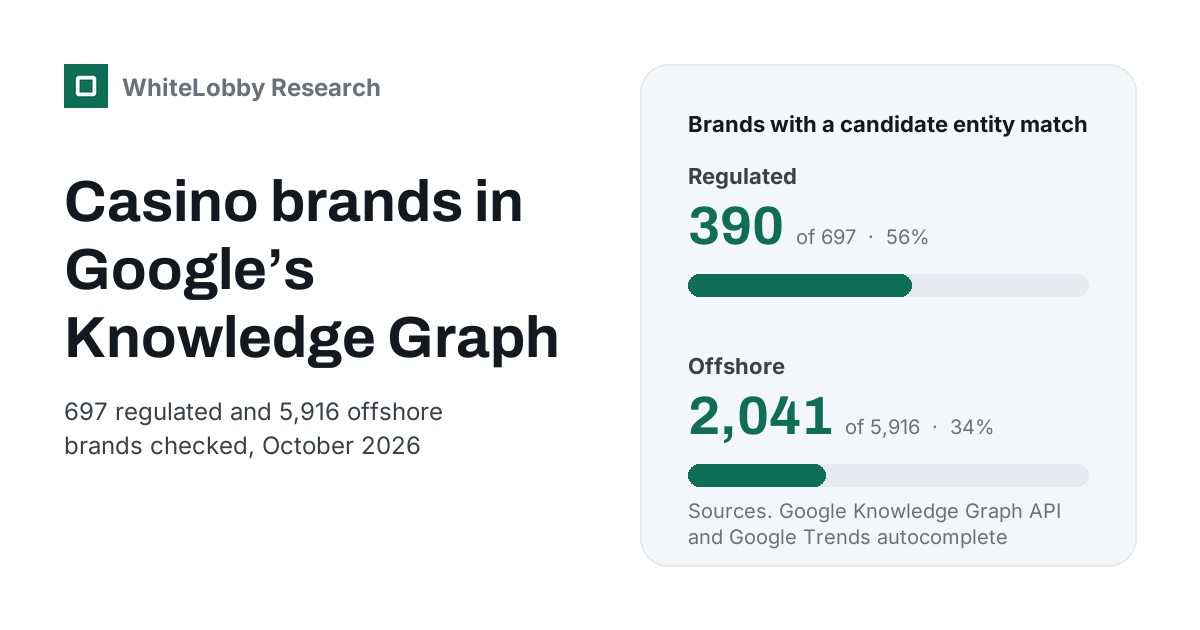
We found candidate entity matches for 390 of 697 regulated casino brands and 2,041 of 5,916 offshore brands in Google’s Knowledge Graph. Many matching records had no label explaining what kind of entity they represented. Among the company entities we confirmed, descriptions were often missing. Almost every description we did find cited Wikipedia.
An entity is a record in Google’s Knowledge Graph for a person, organisation, product or other subject. We counted a record as a candidate match when its name, website or app listing matched the casino brand and we had not identified it as unrelated. Some records described companies with founding dates and headquarters. Others described apps or games. Some gave us too little information to establish whether they represented the casino.
We ran the searches on 5 and 6 October 2026. We recorded the labels Google returned for each matching entity. For company and organisation entities, we also checked whether they represented the casino business. We then examined the confirmed entities’ Google results pages for facts about the business, description sources and sites in the top 10 organic results.
We found matches for 390 regulated brands and 2,041 offshore
For 307 regulated brands and 3,875 offshore brands, our searches either found no matching record or returned only records we excluded as unrelated.
| Results of our entity searches | Regulated brands | Offshore brands |
|---|---|---|
| Brands checked | 697 | 5,916 |
| Brands with a candidate entity match | 390 | 2,041 |
| Brands with no match found after exclusions | 307 | 3,875 |
| Brands with a manually confirmed company entity | 55 | 32 |
The candidate totals include records labelled Topic or Thing. Those labels did not tell us what the subject was, so we could not confirm that every such record represented the casino.
An unsuccessful search also did not prove that a brand had no entity anywhere in Google’s graph. Our API queries requested up to 10 results, and Trends returned up to five suggestions. Both limits were reached on numerous queries.
The regulated and offshore groups stayed separate throughout the research. They cover different licensing registers, and the results describe these samples rather than every casino worldwide.
A matching record could be an app or just a name
Google returned at least one matching entity labelled Topic for 342 regulated brands and 1,883 offshore brands. For 53 regulated brands and 241 offshore brands, we found at least one matching entity whose only type was Thing.
Neither label identified the record as a casino, company or app. We included these records as candidate matches because they matched the brand, but their identity remained unconfirmed.
Other records were more specific. Among regulated brands, 69 had an entity labelled Software, 60 had one labelled Online game, and 33 had one labelled Video game. The exact label Gambling company appeared for 15.
These categories overlap. One brand can have several records, and Google uses several different company labels.
32Red illustrates that variety. We found six entities matching its name. One represented the casino company and another its app. Three were untyped Topics. The sixth was a musical artist. An app entity can legitimately represent a casino’s product.
For 32Red, counting the company, the app and the untyped records together would hide the differences between them. We recorded their types separately and excluded the musician.
We confirmed company entities for 32 offshore brands and 55 regulated brands
Our searches returned company or organisation entities matching the names of 73 offshore casino brands. We checked those entities by hand. For 32 brands, we confirmed a company entity representing the casino business. For 30, the matches belonged to unrelated organisations. For 11, we could not establish whether the entity represented the casino.
In the regulated group, 58 brands had company or organisation matches. We confirmed company entities for 55. The matches for the other three belonged to unrelated organisations.
For example, a search for High Flyer Casino returned a company entity called High-Flyer. Its Google results page identified it as a Chinese hedge fund, so we excluded that entity from the casino results.
Checking the company’s description let us distinguish a casino entity from an unrelated business with a similar name.
The 55 confirmed regulated brands had 63 company entities between them. The 32 confirmed offshore brands had 33. Some brands had more than one company entity, so the entity counts exceed the brand counts. We examined all 96 confirmed company entities for business facts and description sources.
Wikipedia supplied 37 of 38 regulated company descriptions
Of the 63 confirmed regulated company entities, 38 had a descriptive paragraph on the Google results page fetched through DataForSEO. Of those descriptions, 37 cited Wikipedia. The remaining one cited Google’s own business listing.
Of the 33 confirmed offshore company entities, five had a descriptive paragraph. Four cited Wikipedia and one cited a Google business listing.
That left 25 regulated company entities and 28 offshore company entities without a descriptive paragraph in the returned data.
For InterCasino, the Wikipedia-sourced description credited the organisation with establishing the first online casino in 1996. That gives a reader a history. Many other confirmed company records offered no comparable introduction.
Wikipedia was the cited source for nearly every company description we observed. In our experience, a Wikipedia article is enough to get a knowledge panel.
Founding dates appeared for 46 of the 63 regulated company entities and 19 of the 33 offshore company entities. Headquarters appeared for 17 regulated entities and two offshore. A CEO appeared for six regulated entities and one offshore.
For 15 regulated company entities and 13 offshore company entities, DataForSEO returned no factual attributes from the panel, such as a founding date, founder or headquarters. Confirming that a record represented the casino did not mean it contained those business details.
The API returned matches for 207 regulated brands and 466 offshore
We used two tools to find entities. Google’s Knowledge Graph API returned candidate matches for 207 regulated brands. Google Trends autocomplete returned matches for another 183 regulated brands that our API searches had not found. Together, the tools found candidate matches for 390 regulated brands.
For offshore brands, the API returned candidate matches for 466. Trends found matches for another 1,575 brands that our API searches had not found. Together, they found candidate matches for 2,041 offshore brands.
Our API searches therefore captured about 53% of the regulated brands with retained matches and 23% offshore.
The remaining retained matches appeared only through Google Trends autocomplete.
A search using only the API would therefore have missed candidate matches for 183 regulated brands and 1,575 offshore brands that we found through Trends.
These percentages describe our queries and results. They are not a measure of the API’s coverage of Google’s entire Knowledge Graph.
Trustpilot appeared in the top 10 results for 17 regulated company entities
For each confirmed company entity, we also recorded the top 10 organic results on its Google results page. Trustpilot appeared for 17 regulated company entities and 12 offshore company entities. YouTube appeared for 15 regulated entities and eight offshore. X appeared for 11 regulated entities and nine offshore.
Google returned organic results for 59 of the 63 regulated company entities and for all 33 offshore. For 24 of those regulated entities and 19 offshore, none of the results sat on a domain the brand had registered with its regulator. A site on another domain the brand may own, such as a country version the register does not list, counted as unrelated.
We searched using the entity’s name and its unique Google ID. These results describe searches for a specific entity. They do not show what a customer would necessarily see after typing only the casino name.
An appearance in organic results also does not establish that Google used the site as a source for the knowledge panel. Wikipedia’s description citations and Trustpilot’s search appearances are separate observations.
How we checked
We built the samples from the casinolicensecheck.com dataset, drawn from official registers read on 28 and 29 September 2026.
The regulated group covered qualifying brands from the UKGC, Ontario, Germany and Brazil registers. The offshore group covered qualifying B2C brands from Anjouan, Curacao and Malta, excluding brands already in the regulated group. Brands appearing on several registers counted once, and numbered mirror domains were consolidated.
Each brand received a name query, followed by either its name plus “casino” or its name with “casino” removed. We used the Enterprise Knowledge Graph API and Google Trends autocomplete.
The API’s 10-result limit was reached on 205 regulated and 997 offshore queries. Trends’ five-suggestion limit was reached on 722 and 3,508 queries, respectively. Additional matches may exist beyond the results fetched.
We matched names after ignoring case, punctuation and the words casino and online. We also accepted matches through the brand’s website domain or an app listing whose name began with the brand name. We excluded identified unrelated entities and checked company and organisation matches by hand using Google results pages fetched through DataForSEO. The cleaned export records each entity’s inclusion or exclusion and the reason.
This research measures entity discovery and information displayed for confirmed company entities. It does not establish whether a knowledge panel appears when a customer searches a brand name.
Build a knowledge panel for your casino brand
WhiteLobby helps casino and sportsbook brands establish their presence in Google’s Knowledge Graph and build or improve their knowledge panels. We work on the entity records, supporting sources and brand information that give the panel its substance.