News
A scam ad borrowed Martin Lewis, the BBC and HSBC. None of them knew.
Updated 24 November 2026
The scammer paid only for an ad slot. Three trusted names did the selling, and they are the ones readers will blame when the money is gone. Any brand can be borrowed this way, a casino, a sportsbook or a payment company included, and the funnel has one weak point, the search a careful reader runs before paying. WhiteLobby works on that point for the brands it protects, and this case shows why it matters.
In November a compliance specialist posted on LinkedIn about an ad in the Flashscore app that read "Martin Lewis Sacked". It led to a page dressed as BBC News, and halfway down that page sat a sign-up form for a trading app called SurreymontePro, next to a screen styled as an HSBC account.
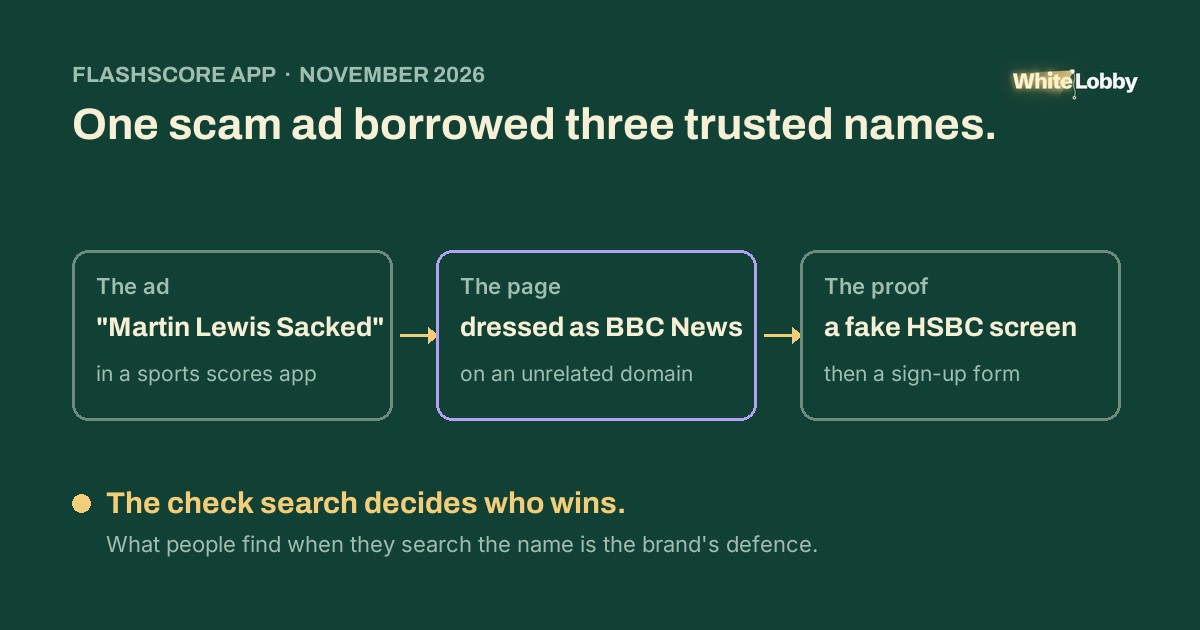
How the scam ad funnel works, step by step
- A headline about a famous name. The ad appeared in Flashscore, a sports scores app with a large UK audience, between the NFL results and the app's own news. Martin Lewis is a well-known UK consumer finance journalist, and a headline about him gets clicks.
- A page dressed as a trusted publisher. The click opened fantasticdalmatian.media, styled with the BBC logo, the red News bar and a Business menu. The story claimed Martin Lewis clashed on air with Andrew Bailey of the Bank of England over a way for ordinary people to make money.
- Proof in a bank's colours. A reader quote described a GBP 275 deposit growing to GBP 10,900 in 30 days, illustrated with a screen styled as an HSBC account.
- The form. Links and a sign-up form for SurreymontePro closed the page. We checked the FCA Register on 24 November 2026 and found no authorised firm under that name.
Who pays for borrowed trust
The names that were borrowed carry the cost. The scammer pays for an ad slot. Martin Lewis, the BBC and HSBC pay with trust, because a person who loses a deposit remembers "the BBC article" and "the HSBC screen", and a domain like fantasticdalmatian.media is soon forgotten.
The app that showed the ad is exposed too. The author of the post wrote that they do not blame Flashscore and expected the ad network's fraud checks to stop the advertiser. Readers still saw the scam inside an app they use every day.
The check search decides who wins
A careful reader checks the name before paying. The author of the post did exactly that. They searched SurreymontePro and reported several similar domains, no FCA regulation, unclear ownership and no reviews anywhere. That search stopped the scam for one reader.
What a search shows at that moment works as the brand's defence. A person who searches the borrowed brand together with the headline, or asks an AI assistant whether the story is real, should find the brand's own answer first. When the official pages are weak on that query, a third-party website using the brand's name has room to look plausible.
The same funnel in iGaming and payments
Any trusted name can be the one that gets borrowed. A casino or sportsbook brand can appear as the place where the fake winnings came from. A payment brand or a bank can appear as the screen that proves the money arrived, just as HSBC did here. Operators and payment companies spend years building the trust these funnels take for free.
- A news-style page that names your brand in a story you never gave.
- A screenshot styled as your app, your cashier or your account page.
- A sign-up form that sits under your logo and collects deposits for someone else.
What we do when your name is used
WhiteLobby starts with the evidence. We capture every page that uses your name, with its address, time, market and the path a visitor took to reach it. Then we trace who profits, through the host, the registrar, the ad network and any affiliate or payment partners named in the links. Each of them can act, and we report to all of them in parallel. Our guide on what to do when someone uses your name on another website walks through the same layers for a stolen identity.
WhiteLobby also works on the search side. We make your own pages, profiles and entity data the answer that Google and AI assistants give when people check your name, so the next borrowed-name page fails at that check.
How we keep it from working
For brands WhiteLobby works with, we watch new domains and pages that use the brand's name and what people see when they search it. A page dressed in your colours gets caught in its first days, while it is still a short list of hosts and platforms to contact.
What do people find when they check your name?
We look at your brand's search results and AI answers, and at the third-party websites using your name.
Ask us to check your brand or email hello@whitelobby.comSources
- Brean Wilkinson, compliance and regulatory specialist, LinkedIn post with screenshots of the ad and the page, November 2026
- FCA Register, firm search for SurreymontePro with no result, checked 24 November 2026
See how we protect iGaming brands across search and AI and how we protect payment brands.